
An Introduction to D.G. Rossetti
Jerome J. McGann
University of Virginia

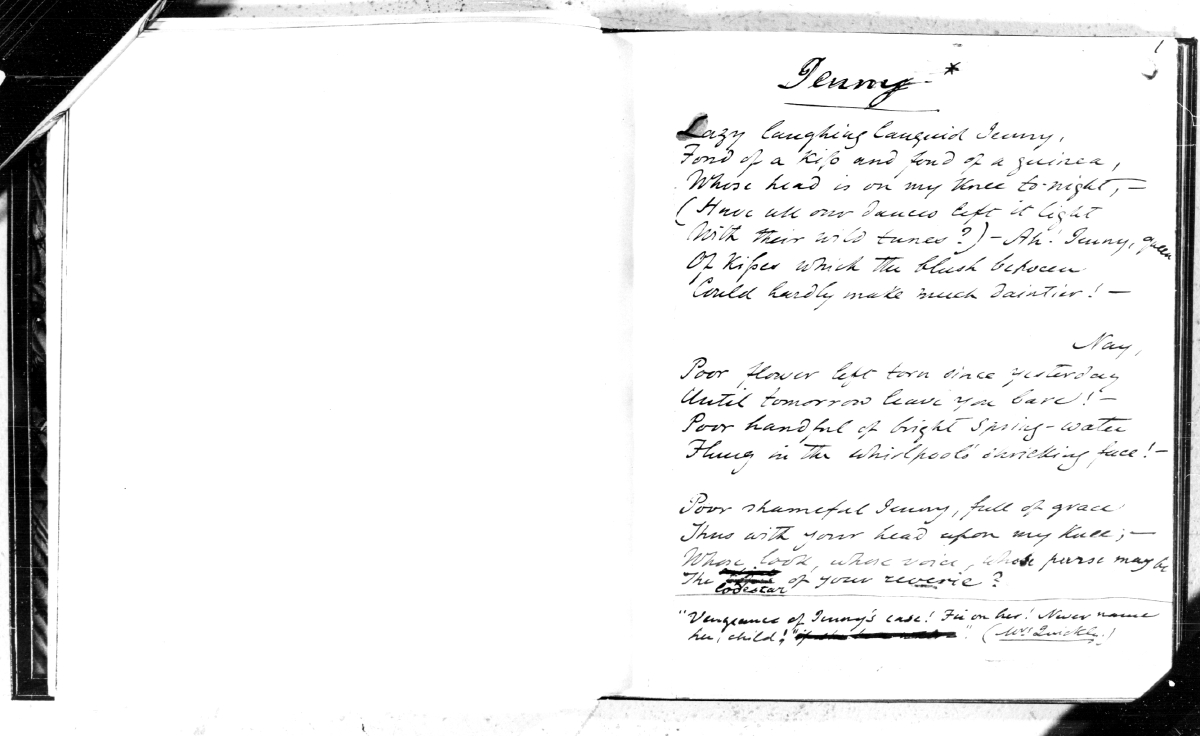
This is the first page of Rossetti's corrected manuscript copy of "Jenny", his celebrated dramatic monologue on the "modern life" subject of prostitution.
The manuscript is housed in the library of the Fitzwilliam Museum.
|
This kind of imaginative work leads Rossetti to his theory of "the inner standing-point" as one of the "motive powers of art". The key text is Rossetti's discussion of "Jenny" in "The Stealthy School of Criticism," his 1871 critical response to Buchanan's attack on his poetry. Like Ruskin earlier, Buchanan was offended and troubled by "Jenny." The subject was problematic to a degree, but worse was the intimate way Rossetti handled his materials. Would "a treatment from without" - for instance, a prose essay on the subject - have been preferable? Rossetti says "no." The more difficult the material, the more one needs an imaginative rather than an expository approach: for "the motive powers of art reverse the requirement of science, and demand first of all an inner standing-point. The heart of such a mystery as this must be plucked from the very world in which it beats or bleeds." |
|
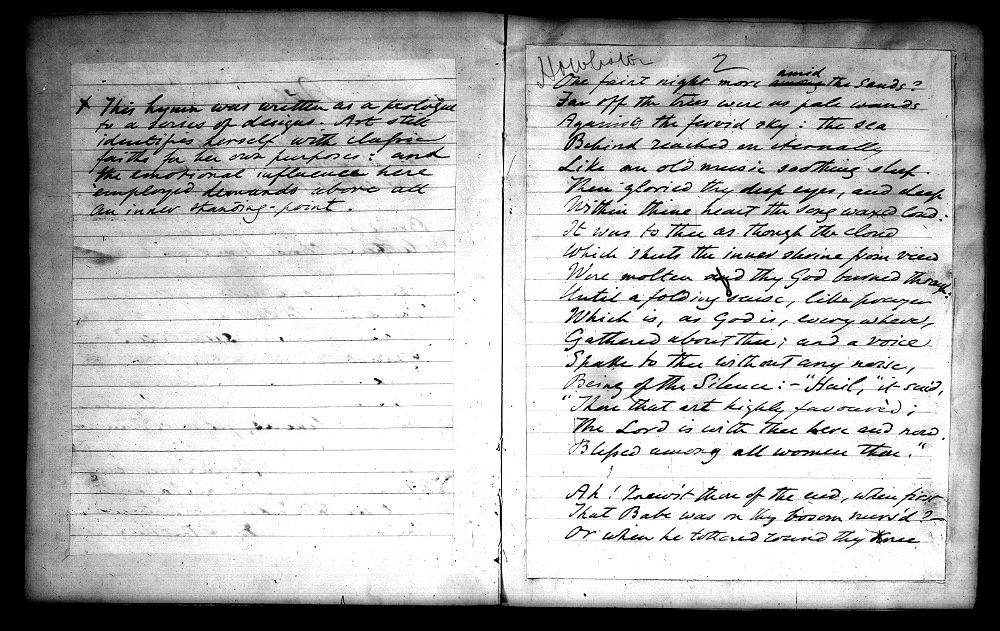
Rossetti had introduced the theory of the "inner standing-point" some
years before, in an unpublished note to his pastiche poem "Ave", one of his early "Songs of the Art Catholic".
The idea of art at an "inner standing-point" is a clear theoretical
reflection on the dramatic monologue, and especially on Robert
Browning's use of the form, which Rossetti much admired. Rossetti's
thoughts on this genre, however, are quite different from Browning's -
both in 1847-1848, when he wrote "Ave" and in 1859 and 1871, when his
focus of attention was on "Jenny". Rossetti's comment is arguing that
an "inner standing-point" is not simply a feature of a particular genre
or poetic form, it is a foundational requirement of "art". Not just
writing, not just poetry, but "art" in general.
|
Two pages from Rossetti's corrected fair copy manuscript of his pastiche poem "Ave", one of the so-called "Songs for the Art Catholic" that he worked at in the late 1840s. Reproduced are the verso of leaf 1 and the recto of leaf 2. The verso carries Rossetti's important note about writing from "an inner standing point", an idea he would put forward again in his critical apologia "The Stealthy School of Criticism" (1871).
This manuscript is located in the Taylor Collection, Princeton University Library.
|
When a poetics of the inner standing-point is undertaken in a poem of contemporary life such as "Jenny", the results are very different from those gained when Rossetti wrote "Ave". The world of "Jenny" is no lost spiritual dreamland, it is an all-too-present nightmare. Readers to this day argue about whether the "young and thoughtful man of the world" (as Rossetti called him) is offered for our judgment or our sympathy, and about Rossetti's relation to his imaginative figure. But the poem incarnates a structure of doubtfulness by troubling every effort to reach a normative or stable judgment on the characters or the situation. Biographically inflected readings of the poem — they are common — underscore this difficulty. The more explicit of these readings range between praise for Rossetti's enlightened or brave undertaking in the poem to sharp criticism of his sexist and pornographic illusions.
Rossetti's theory of the inner standing-point involves a major rewriting of the sympathetic contract poetry and art make with both their subjects and their readers. Romantic sympathy in its most authoritative cultural form displays - as Keats famously put the matter - "the holiness of the heart's affections". In this view, because the artist is imagined to have clearest access to that holy place, the artistic act becomes a moral and spiritual standard. Arnold would authorize this set of attitudes when he argued that poetry would replace religion for persons living in the modern world. His sonnet "Shakespeare" represents this set of ideas about the transcendental status of poetry:
Others abide our question. Thou art free.
We ask and ask, thou smilest and art still,
Outtopping knowledge.
That is the romance - really, the romanticism - of an art conceived as some still point of a turning world. Rossetti's aesthetic move called such a view into radical question. Or perhaps one should say, Rossetti exposed the bad faith on which it had come to rest, for the authority of Arnold's sonnet is pure illusion, as Arnold himself showed in other of his poems, especially a devastating work like "The Buried Life." In Rossetti's story "Hand and Soul" the exposure comes when Chiaro, Rossetti's surrogate, poses this question for himself and his art: "May one be a devil without knowing it?" If the heart and its affections are that problematic, the ground of sympathy will only be gained through what Tennyson called, in one of his wittiest and wickedest moments, "honest doubt".
|
Not without cause, then, do readers follow Ruskin and Buchanan in recoiling from the poem. Its space is treacherous, as we see with special clarity in the marvelous line "Ah Jenny, yes, we know your dreams". Readers will scarcely miss the folly exposed here in the young man's facile judgment, and if we also see Rossetti reflected in the poem - as we often do - we may be led to rethink that line, as if it might also have said: "Ah, Rossetti, yes, we know your dreams." But Rossetti is not alone engulphed in this cunning text. That first-person plural pronoun snares the reader as well. If Jenny has dreams, readers make representations of those dreams. What "we" in fact know are nothing more than representations of representations. Although criticism and critics regularly covet definitive judgment and understanding, Rossetti's poetic method undermines that obscure object of desire. A poem like "Jenny" is a dangerous critical mirror that turns the readers' eye back on themselves.
|
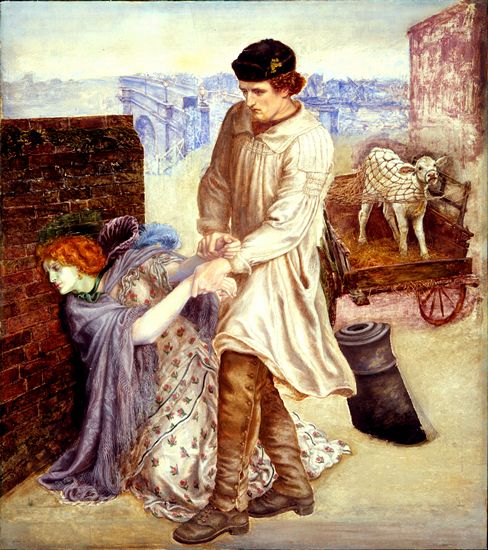
Rossetti began this famous picture, "Found", in the early 1850s but never completed the oil version he had projected. "Found" is a double work and, as in nearly all cases with Rossetti, the picture called forth the accompanying sonnet. The sonnet was written early in 1881 when Rosseti was once again working hard at completing this painting. This double work is closely related to the poem "Jenny".
The painting is located in the Delaware Museum of Art.
|
But when we read Rossetti we really must think not of them, for Rossetti has his music too. "Recondite... casuistical... obscure": Pater's shrewd terms define a poet whose access to psychic recesses is acute precisely because he writes about them from an inner standing-point and because he is so assiduous in his explorations. Rossetti's obsessive corrections and revisions carry him into deep waters, nor does it matter if his brainwork continues to mask or to unmask his process of thought. Either way we get uncommon revelations, for the writing is, in the end, a reciprocal play of both.
This work is licensed under a Creative Commons Attribution 3.0 United States License.